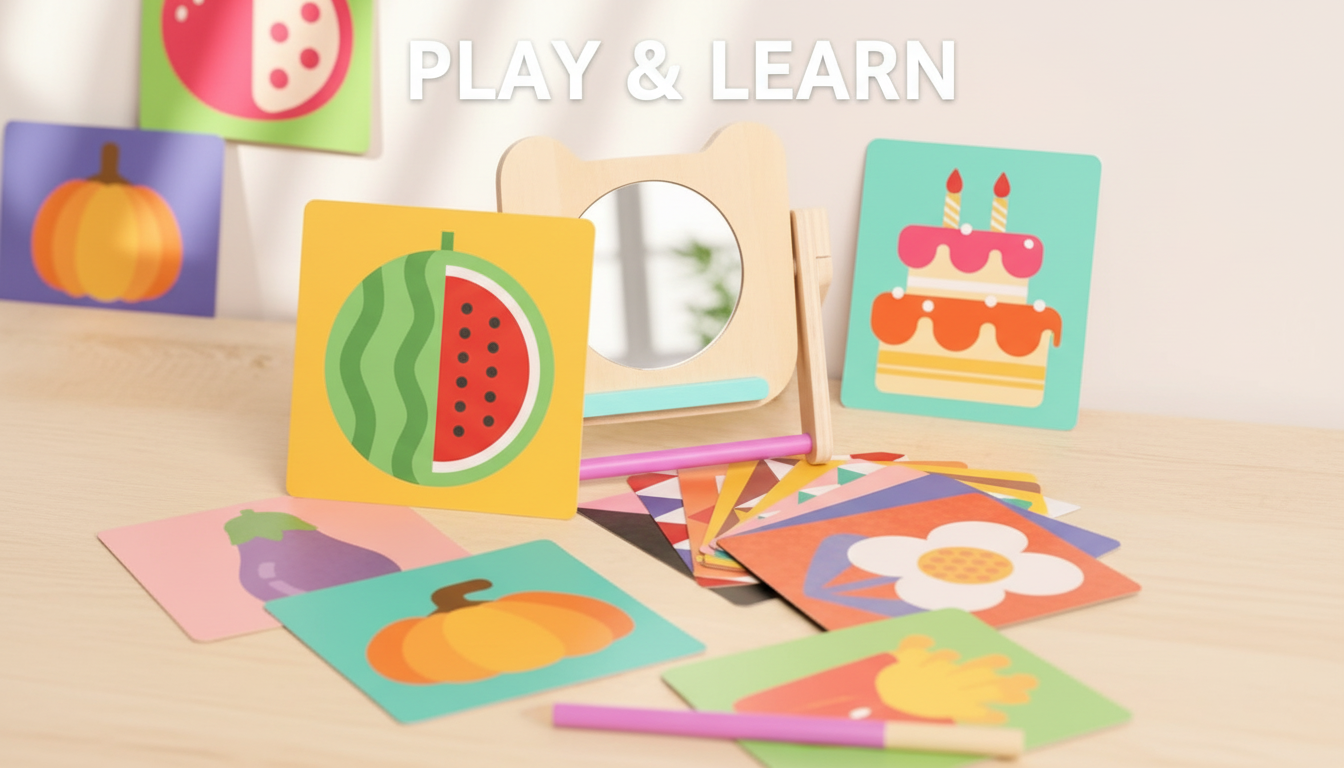
High-contrast images and a safe baby mirror can turn everyday floor time into focused visual exploration. This set is designed to support early attention, tracking, and curiosity with simple, bold patterns that are easier for many newborns to notice during the first months. With a calm, uncluttered setup, babies get a chance to look, pause, and re-engage at their own pace—an approach that fits naturally into Montessori-style routines.
Why high-contrast visuals matter in the early months
Newborn vision develops quickly, but early on it’s still limited in clarity and contrast sensitivity. Bold black-and-white patterns are typically easier to detect than soft pastels or detailed illustrations, which can look “busy” or fade into the background. When a baby can actually see what’s in front of them, they’re more likely to settle into quiet attention rather than darting their gaze around.
Short, repeatable visual activities also help babies practice smooth tracking—learning to follow a shape with their eyes as it moves slowly. Keeping the materials simple supports a Montessori-style rhythm: one clear visual focus, brief engagement, and baby-led observation rather than constant switching and stimulation.
For a quick overview of early visual milestones, you can also reference guidance from HealthyChildren.org (American Academy of Pediatrics) and the National Eye Institute (NIH).
The Montessori High Contrast Baby Mirror & Flash Cards Set is built around two straightforward tools for early visual play:
- A baby-safe mirror intended for supervised tummy time and visual exploration.
- High-contrast flash cards featuring bold shapes and patterns for early visual stimulation.
- A compact, grab-and-go setup that works on a play mat, in a nursery corner, or during short wake windows.
- Designed as a set so the mirror and cards can be rotated to keep interest without overstimulating the space.
Because the visuals are intentionally simple, it’s easy to keep the environment calm: one card at a time, a steady viewing position, and plenty of pauses.
How to use the mirror and cards for calm, focused play
Set up on the floor
Place your baby on a firm, flat surface (like a play mat) with an adult nearby. Position one card at a time in your baby’s line of sight. If you’re using the mirror, keep it stable so it doesn’t tip or slide toward the baby.
Try brief sessions and follow cues
Start with 30–90 seconds and increase gradually based on your baby’s cues. Looking away repeatedly, fussing, yawning, or arching can all mean “I’ve had enough for now.” Multiple short sessions tend to work better than one long session.
Support tummy time without pressure
For tummy time, place the mirror slightly in front of your baby to encourage lifting the head. Keep the angle low and steady. If your baby tires quickly, switch to a side-lying position and bring a single high-contrast card into view.
Practice tracking with slow movement
Move one card slowly left to right a few inches at a time, then pause so your baby can refocus. Slow and predictable is the goal—quick movement can make it harder to follow and can feel overstimulating.
Rotate patterns gently
Instead of showing many cards at once, swap a card every few days. This keeps the environment simple while still offering something “new” when interest fades.
Age-by-age ideas: from newborn to early sitters
Babies change quickly in the first months, so small adjustments in distance and duration can make visual play more comfortable and effective.
Quick guide for setup, distance, and session length
| Age range |
Best activity |
Suggested distance |
Typical session |
| 0–4 weeks |
Single card viewing |
8–12 inches |
30–60 seconds |
| 1–3 months |
Slow tracking + mirror tummy time |
10–14 inches |
1–3 minutes |
| 3–6 months |
Side-to-side attention shifts |
12–18 inches |
2–5 minutes |
| 6+ months |
Naming shapes/patterns; mirror discovery |
18+ inches (as tolerated) |
3–7 minutes |
Montessori-style tips to keep it baby-led
Safety and care during mirror and card play
When this set makes a thoughtful gift
Product details and where to find it
More in-stock finds
FAQ
When can a baby start using high-contrast cards?
Many babies can benefit from simple high-contrast visuals from the newborn stage. Keep viewing close (about 8–12 inches) and sessions very short, and always follow your baby’s cues for interest and comfort.
How long should a high-contrast play session last?
Often just 30 seconds to a few minutes is plenty, especially in the early weeks. End the session when your baby looks away repeatedly or starts to fuss, and try again later rather than extending one session.
Is a baby mirror safe for tummy time?
A mirror designed for babies can be used safely with direct supervision, stable placement on a flat surface, and regular inspection. Avoid using any mirror that’s cracked, has sharp edges, or can tip or slide toward your baby.
Recommended for you



Leave a comment