100W USB‑C to USB‑C Fast Charging Cable (PD 3.0 + QC 4.0, 5A): What It Does and When It Matters
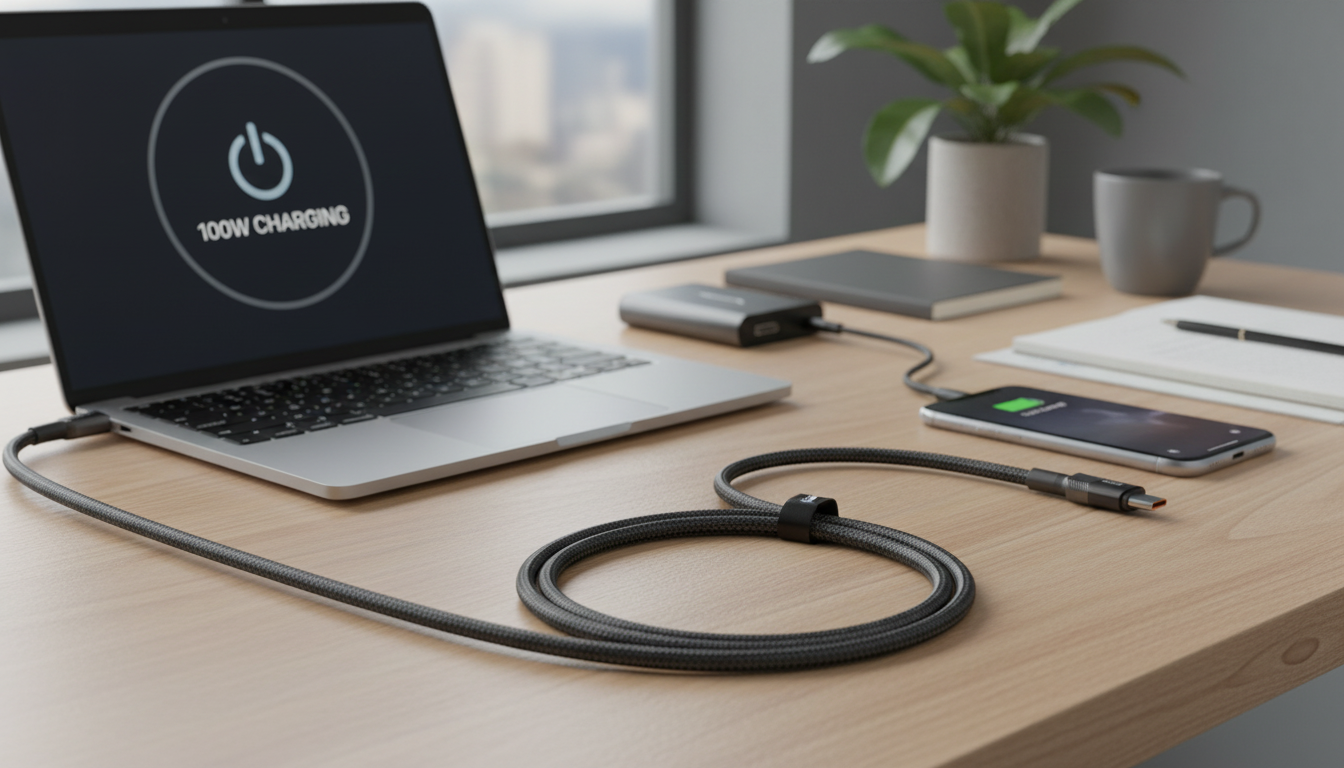
A high‑power USB‑C to USB‑C cable can be the difference between slow “maintenance charging” and full-speed charging for laptops, tablets, and phones. This guide breaks down what 100W, 5A, PD 3.0, and QC 4.0 mean in real use, how to confirm compatibility, and what to look for to keep charging fast, stable, and safe.
What a 100W USB‑C to USB‑C cable is designed for
A 100W USB‑C to USB‑C cable is built for higher power delivery across a wide range of modern USB‑C devices, from phones and earbuds to tablets and many laptops. The key advantage is flexibility: one cable that can cover daily charging needs without constantly swapping between “phone cables” and “laptop cables.”
- Supports higher power delivery for devices that charge over USB‑C, including many laptops, iPads/tablets, handheld consoles, and Android phones.
- A 100W rating typically targets up to 20V/5A power profiles when paired with a compatible USB‑C Power Delivery (PD) charger.
- Best fit for users who want one cable that can handle both small devices (earbuds, phones) and larger ones (ultrabooks) without swapping cables.
- Useful for travel kits where a single high-watt cable and a PD charger can cover multiple devices.
Even when a device doesn’t need anywhere near 100W (most phones don’t), using a higher-capacity cable can help prevent the cable itself from becoming the bottleneck—especially when the charger and device are capable of faster charging.
Understanding PD 3.0, QC 4.0, and the “5A / 100W” rating
USB‑C charging speed depends on negotiation between the device and the charger, and the cable has to support the requested power level. That’s why labels like PD 3.0, QC 4.0, 5A, and 100W matter.
- USB Power Delivery (PD 3.0): A USB‑C standard that negotiates voltage/current between charger and device so the device draws only what it can safely use. More details are available from the USB‑IF: USB Power Delivery.
- Quick Charge (QC 4.0): Qualcomm’s fast-charging approach; many modern devices still fall back to PD over USB‑C, but QC compatibility can help with certain phones/chargers. Reference: Qualcomm Quick Charge 4 Technology.
- 5A capability: Reaching the highest USB‑C PD power levels requires a cable built for higher current; many basic USB‑C cables are limited to 3A.
- 100W capability depends on the full chain: device support + charger support + cable support. The lowest-capability component determines the actual charging speed.
Common charging outcomes (device + charger + cable)
| Scenario |
Typical result |
What to verify |
| Laptop with USB‑C PD + 100W PD charger + 5A/100W cable |
High-speed charging up to the device’s max |
Device wattage requirement (e.g., 45W/65W/100W) |
| Phone with PD fast charge + PD charger + 100W cable |
Fast charging (often 18W–45W depending on phone) |
Phone’s supported PD profile |
| High-power device + PD charger but a 3A-only cable |
Charging may cap below max power |
Cable current rating (3A vs 5A) |
| Any device + non-PD low-watt charger |
Standard/slow charging |
Charger output (PD support and wattage) |
If you want a quick refresher on the connector standard itself, the USB‑IF overview is helpful: USB Type‑C.
Compatibility checklist before buying or upgrading
High-watt charging is simple when the essentials line up. Before upgrading, check the device, the charger, and the cable as a system.
Safety and durability: what affects reliability over time
Everyday use cases where 100W makes a difference
Product options in stock
Quick specs snapshot
| Feature |
Detail |
| Max charging support |
Up to 100W (5A) with compatible PD charger/device |
| Fast-charge protocols |
PD 3.0, QC 4.0 (device/charger dependent) |
| Connector type |
USB‑C to USB‑C |
| Best for |
Laptops, tablets, phones that charge over USB‑C |
FAQ
Will a 100W USB‑C to USB‑C cable make my phone charge faster?
Only if your phone and charger already support a higher fast-charge level and the cable was the limiting factor. A 100W/5A cable helps prevent cable bottlenecks, but it can’t make a phone exceed its own supported charging wattage.
Do I need a special charger to use a 100W USB‑C cable?
No—any USB‑C charger can work for basic charging. To reach higher wattage (like 45W, 65W, or 100W), you’ll need a USB‑C Power Delivery charger with enough output and a device that supports those PD power levels.
Why does my laptop still show “slow charging” with a high-power cable?
The most common cause is a charger that doesn’t provide enough wattage or doesn’t support USB‑C PD. It can also happen due to a non-PD port, a dirty or worn port, a long cable causing voltage drop, or the laptop negotiating a lower PD profile based on conditions.
Recommended for you





Leave a comment